Most restaurants try to improve the customer experience by fixing one thing at a time: a faster POS, a friendlier host, a new menu design. But guests don’t experience your restaurant as a list of features. They experience it as a single, continuous story that starts long before they sit down and ends days after they leave. If even one chapter of that story breaks, the whole experience suffers.
In 2026, the restaurants winning on retention aren’t the ones with the fanciest dining rooms. They’re the ones that have mapped the entire guest journey, identified where friction silently kills repeat visits, and rebuilt those moments one by one.
What is a restaurant guest journey map?
A guest journey map is a step-by-step view of every interaction a customer has with your restaurant, from the moment they first hear about you to the moment they decide whether to come back. Each step is a chance to delight or disappoint, and most operators are losing customers at touchpoints they’ve never even thought about.
A useful map covers five stages:
- Discovery: how guests find out you exist (Google, social, word of mouth, delivery apps).
- Decision: what convinces them to choose you over a competitor (reviews, photos, menu, hours, response speed).
- Pre-visit: reservation, parking, arrival, wait time.
- In-restaurant: greeting, seating, ordering, food quality, pacing, payment.
- Post-visit: follow-up, review request, loyalty offer, next-visit trigger.
Stage 1: Discovery friction
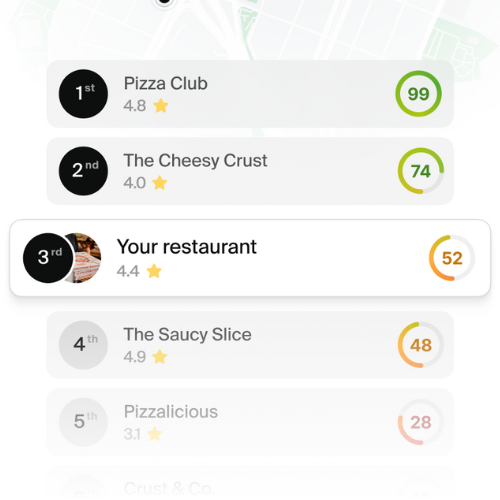
Before anyone tastes your food, they Google you. If your Google Business Profile is incomplete, your photos are dark, or your hours are wrong, you’ve already lost the guest. Industry data consistently shows that more than 80% of diners check a restaurant online before visiting, and a single outdated detail can send them to a competitor.
How to fix it: audit your Google Business Profile every quarter. Update photos with recent dishes, verify hours (including holidays), respond to every review within 48 hours, and add menu links that actually work on mobile.
Stage 2: Decision friction
Once a guest finds you, they spend less than a minute deciding whether to come in or order. Look at your own profile through their eyes:
- Is your average rating above 4.3 stars?
- Are negative reviews answered with care, not defensiveness?
- Are your top dishes visible in the first three photos?
- Can a guest order online or book a table in two clicks?
If the answer to any of these is no, that’s a friction point worth more than any new menu item.
Stage 3: Pre-visit friction
The 30 minutes before a guest sits down set the emotional tone of the entire visit. A confusing reservation flow, a vague address, a 15-minute wait without acknowledgment — these are the moments where good food can’t save the experience.
How to fix it: use a commission-free reservation tool that confirms instantly, sends reminders, and lets guests modify or cancel without calling. When a guest arrives, acknowledge them within 30 seconds, even if you can’t seat them yet. A simple “We see you, give us five minutes” is worth more than a free appetizer later.
Stage 4: In-restaurant friction
This is the stage operators obsess over, and rightly so. But the most common friction points aren’t food-related. They’re pacing problems: drinks taking too long, the check arriving before dessert is offered, a server who never checks back. Train your team to think in guest minutes, not kitchen minutes. Every minute a guest waits for something they didn’t ask to wait for is a minute spent eroding the experience.
Stage 5: Post-visit friction (the most ignored stage)
This is where most restaurants disappear. The guest leaves, and nothing happens. No thank-you message, no review request, no reason to come back. Meanwhile, the chain down the street is sending a personalized offer 48 hours later and recapturing the visit.
A simple post-visit sequence — a thank-you message, a review request 24 hours after the visit, and a personalized offer two weeks later — can lift repeat visit rate by double digits. The technology to do this in 2026 is cheap, fast, and entirely automatable.
How to actually map your journey this week
- Walk it yourself. Search your restaurant on Google as if you’d never heard of it. Try to book a table. Order delivery. Note every micro-frustration.
- Ask five recent guests. Call or message five people who visited last month. Ask what almost stopped them from coming, and what almost stopped them from coming back.
- List every friction point. Write each one on a sticky note. Sort by frequency and by emotional impact.
- Fix one stage at a time. Don’t try to fix all five at once. Pick the stage with the most friction and the cheapest fixes, and rebuild it over two weeks.
Why this matters in 2026
Acquisition costs keep rising. Delivery commissions keep eating margin. The only sustainable growth lever left for most independent restaurants is retention — and retention is decided at the friction points most operators have never mapped.
RAY helps restaurants do exactly this: it consolidates your Google presence, your reviews, your reservations, and your post-visit communication into a single platform that turns one-time visitors into repeat guests, without depending on third-party platforms that take a cut of every order. If you’re ready to stop fixing your guest experience one feature at a time and start fixing it as a system, talk to our team.