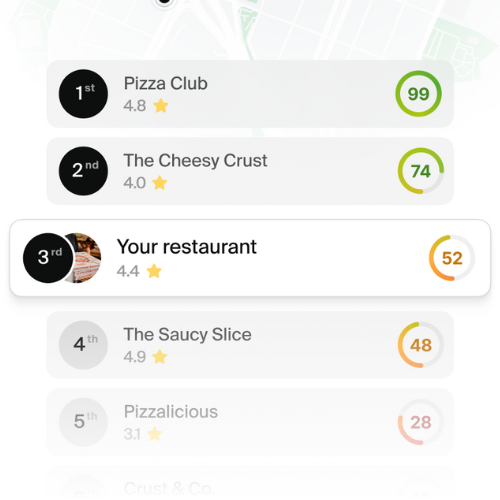

For most restaurants, the difference between a fully booked Friday night and an empty dining room comes down to one tiny piece of digital real estate: the Google Maps Local 3-Pack. That’s the cluster of three businesses Google highlights at the top of the results when someone searches “pizza near me” or “best brunch downtown.” Show up there, and you capture the lion’s share of the clicks, calls, and directions. Stay outside the pack, and you might as well be invisible.
In 2026, ranking in the local 3-pack is harder than ever. AI Overviews now sit above traditional results, voice search has matured, and Google has tightened how it weighs reviews, photos, and on-page signals. Below is a practical playbook for restaurant operators who want to break into the pack — and stay there.
What Google actually ranks in the local 3-pack
Google’s local ranking still rests on three pillars: relevance, distance, and prominence. Relevance is how well your business matches the query. Distance is how close you are to the searcher. Prominence is how well-known and trusted you are online. Distance you can’t change. Relevance and prominence you can.
Step 1: Treat your Google Business Profile like a product page
Your Google Business Profile (GBP) is the most important page your restaurant has — more than your website. Audit it monthly:
- Primary category: Pick the most specific match (e.g., “Neapolitan pizza restaurant” instead of “Italian restaurant”). Add secondary categories that fit.
- NAP consistency: Name, address, and phone number must match across your website, social profiles, and major directories. Inconsistencies kill rankings.
- Hours and holiday hours: Wrong hours are one of the fastest ways to lose trust. Update for every holiday.
- Attributes: Outdoor seating, late-night, vegan options, reservations — fill them all in. They feed long-tail relevance.
- Photos: Upload at least 4 fresh photos per month. Restaurants with 100+ photos get significantly more clicks than those with fewer than 10.
Step 2: Win the review game
Reviews remain the strongest prominence signal for restaurants. The pack winners almost always have more reviews and a higher average rating than the runners-up. Three rules:
- Velocity matters: 30 fresh reviews this month beats 300 reviews from three years ago.
- Respond to everything: Reply to 100% of reviews within 48 hours, including the five-star ones. Google reads your responses as relevance signals.
- Earn keywords in reviews: When customers naturally mention dishes (“the truffle pasta was amazing”), Google indexes those phrases against your profile.
Step 3: Optimize for voice and AI search
By 2026, more than a third of restaurant discovery happens through voice assistants and AI Overviews. Both pull heavily from structured data and conversational content.
- Add LocalBusiness and Restaurant schema to your website.
- Publish a clear FAQ page answering questions in natural language: “Do you take reservations on Sundays?”, “Is parking available?”, “Do you have gluten-free options?”
- Make sure your menu is in HTML text — not trapped inside a PDF or image. AI crawlers can’t read images well, and they punish you for it.
Step 4: Build location-relevant authority
Prominence isn’t just about reviews. Google also looks at whether other trustworthy local sources mention you. Aim for:
- Listings on TripAdvisor, Yelp, Foursquare, and your local tourism board.
- Mentions in local food blogs, news outlets, and “best of” roundups.
- Backlinks from neighborhood associations, event partners, and local suppliers.
Quality beats quantity. One link from your city’s main newspaper outweighs fifty directory listings.
Step 5: Use Google Posts to stay active
Google Posts (the updates that appear inside your GBP) act as a freshness signal. Restaurants that publish at least one weekly post — a special, an event, a new dish — consistently outrank quieter competitors with otherwise similar profiles.
Step 6: Measure what actually moves you
Pack rankings shift by ZIP code, by query, and by hour. Don’t rely on a single ranking check. Track:
- Local pack share of voice across your top 20 keywords and a grid of locations around your restaurant.
- Direction requests, calls, and website clicks in your GBP insights.
- Review velocity and rating against your three closest competitors.
The bottom line
Winning the local 3-pack in 2026 is a compounding game. The restaurants that show up consistently on every “near me” search aren’t the ones with the biggest budget — they’re the ones that treat their Google Business Profile, reviews, and local content as a daily habit, not a project.
RAY helps restaurants automate exactly this work — collecting more reviews, replying to every guest, optimizing your Google Business Profile, and tracking your local pack performance — so you can focus on what happens inside the dining room. Learn how RAY can grow your local visibility.